


Piperazine
What Is Piperazine
Piperazine is an organic compound that consists of a six-membered ring containing two nitrogen atoms at opposite positions in the ring. Piperazine exists as small alkaline deliquescent crystals with a saline taste. The piperazines are a broad class of chemical compounds, many with important pharmacological properties, which contain a core piperazine functional group. Piperazines were originally named because of their chemical similarity with piperidine, part of the structure of piperine in the black pepper plant . The -az- infix added to "piperazine" refers to the extra nitrogen atom, compared to piperidine. It is important to note, however, that piperazines are not derived from plants in the Piper genus.
Advantages of Piperazine
Generally well-tolerated
While piperazine is generally well-tolerated, it is not without its side effects. The most common adverse reactions include gastrointestinal disturbances such as nausea, vomiting, and abdominal cramps. Some patients may also experience dizziness, headache, and skin rashes. In rare cases, severe reactions like urticaria, fever, and hypersensitivity can occur. It is crucial to discontinue the medication and seek medical advice if any severe side effects are experienced.
Valuable tool in the fight against parasitic infections
Piperazine remains a valuable tool in the fight against parasitic infections, with a proven track record of efficacy and safety. However, like any medication, it must be used correctly and cautiously to maximize its benefits and minimize potential risks. As research continues, we may discover even more about this versatile drug, potentially expanding its use beyond its current indications.


Why Choose Us
Our factory
Sichuan Biosynce Pharmaceutical Technology Co.,Ltd. was founded in 2008. Biosynce specialized in developing, supplying and marketing of pharmaceutical intermediates, API and fine chemical products.
Our products
We offer a variety of transmission components, including sprockets, roller chains, gears, couplings, racks, hubs, pulleys, taper sleeves, bearing seats, and more.
R&D
Our R&D team is composed of highly qualified and experienced doctors and masters, with first-class domestic and foreign pharmaceutical chemistry industry backgrounds, rich R&D and management experience. We can continuously update the product library according to customer needs, and provide more than thousands of products in stock, with packaging ranging from grams to tons, and new stock products are added every day.
Production market
Biosynce have an independent R&D and inspection center to strictly test the quality of products and provide customers with high quality products, our products are widely exported to North America, Europe, Asia and Africa. We aim to establish long-term and mutually beneficial relationships with customers and offer excellent products and services.
How to Use and Dosage of Piperazine
With most dosage forms being tablets, syrup, suspension or granules, piperazine is taken orally. Before taking the medicine, the patient does not need to fast or use bleach.
Dosage of piperazine in the treatment of roundworm is as follows:
Children from 12 years old and adults: 75mg/kg body weight/day. The maximum dose should not exceed 3.5g/day, taken once/day before breakfast or divided into 2-3 times to drink before meals, take the drug for 2-3 days. Children from 2 to 12 years old: 75mg/kg body weight/day. The maximum dose should not exceed 2.5g/day, taken once/day before breakfast or divided into 2-3 times to drink before meals, take the drug for 2-3 days. Children under 2 years old: 50mg/kg/day. Note, the use of piperazine in children under 2 years old requires the supervision of a doctor. The dose of piperazine in the treatment of pinworms in both adults and children is 50mg/kg body weight/day, taken once a day before breakfast or divided into 2-3 times to drink before meals, taking the drug continuously in the morning. 7 days. After 2-4 weeks, use again.
Note, it is necessary to treat roundworms and pinworms with piperazine for all family members. An overdose of piperazine can cause symptoms such as temporary respiratory depression, shortness of breath, muscle fatigue in the extremities, and convulsions. In case of overdose, the patient should be treated symptomatically and support respiratory and circulatory support. If overdose has occurred within a few hours, measures should be taken to perform gastric lavage or induce vomiting.
Piperazine is freely soluble in water and ethylene glycol, but insoluble in diethyl ether. It is a weak base with two pKb of 5.35 and 9.73 at 25 °C.; the pH of a 10% aqueous solution of piperazine is 10.8–11.8. Piperazine readily absorbs water and carbon dioxide from the air. Although many piperazine derivatives occur naturally, piperazine itself can be synthesized by reacting alcoholic ammonia with 1,2-dichloroethane, by the action of sodium and ethylene glycol on ethylene diamine hydrochloride, or by reduction of pyrazine with sodium in ethanol.
A form in which piperazine is commonly available industrially is as the hexahydrate, C4H10N2. 6H2O, which melts at 44 °C and boils at 125–130 °C.
Two common salts in the form of which piperazine is usually prepared for pharmaceutical or veterinary purposes are the citrate, 3C4H10N2.2C6H8O7 (i.e. containing 3 molecules of piperazine to 2 molecules of citric acid), and the adipate, C4H10N2.C6H10O4 (containing 1 molecule each of piperazine and adipic acid).
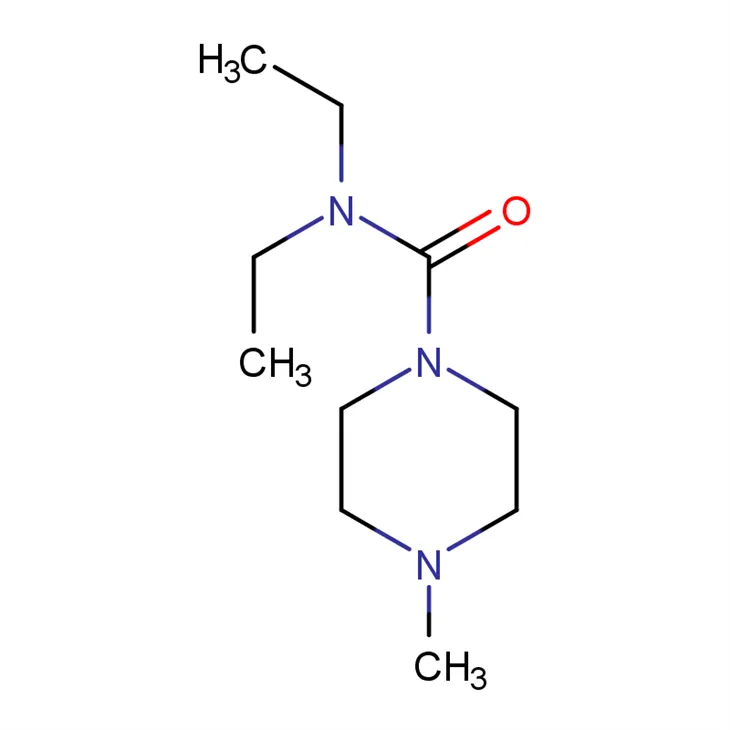

Do not use piperazine in people with hypersensitivity to the ingredients of the drug, people with neurological disease or epilepsy, people with liver and kidney failure. Patients with anemia or severe malnutrition should stop taking piperazine and show signs of hypersensitivity or intolerance to the drug. Pregnant women should only use piperazine if absolutely necessary and there is no alternative because the safety of the drug has not been established. During the first 3 months of pregnancy, the mother should not take the drug because there have been some reports related to malformations in the fetus. Nursing mothers should use caution when taking piperazine because small amounts are excreted in breast milk. However, to date, there have been no reports documenting the effect of the drug on breastfed infants. Concomitant use of high-dose piperazine with chlorpromazine and other phenothiazines may increase the side effects of these two drugs. Therefore, these drugs should not be taken together. Piperazine if used concurrently with bephenium, levamisol and pyrantel cause antagonistic effects. Therefore, these drugs should not be used together. Above is all information about piperazine, patients need to carefully read the instructions for use, consult a doctor / pharmacist before use. Absolutely do not arbitrarily buy piperazine to treat at home because there may be unwanted side effects.
Piperazine belongs to the anthelmintics medicine family. These anthelmintics medicines are mainly used for the treatment of worm infections. These include the infections caused by common roundworms like ascariasis and pinworms like enterobiasis and oxyuriasis. When the piperazine enters the human body, it starts work to paralyze the worms and it will dispose of in the stool. The dosage of piperazine should be determined by the physician.
Piperazines are widely used for the manufacture of plastics, pesticides, resins, brake fluid, and other industrial materials. Piperazine is also used as the fluid for H2S and CO2 scrubbing in addition to methyl diethanolamine
Amine blends are activated by concentrated piperazine and are extensively used for the removal of CO2 for carbon capture and storage (CCS). This piperazine allows for protection from significant thermal and oxidative degradation at typical coal flue gas conditions. The thermal degradation for piperazine and methyl diethanolamine (MDEA) is negligible. This increased stability of MDEA/PZ solvent blend over the MDEA and other amine solvents will provide greater capacity and requires minimum work to capture CO2.
The solubility of piperazine is low. So, a relatively small amount is used to supplement other amine solvents. The performance of one or more piperazines is often compromised due to their low concentration. The addition of piperazine to amine gas is treating solvents and it shows, CO2 absorption, heat absorption, and solvent capacity have increased. These will give typical amine-based absorption processes, which run at temperatures from 45 °C to 55 °C. As the capability of piperazine is within this limit, it supports carbon capture. The piperazine can thermally regenerate with the help of multi-stage flash distillation and other methods, which has operating temperatures up to 150 °C, also it can be recycled back in the absorption process by providing high energy during amine gas treating processes.
The main advantage of using concentrated piperazine (CPZ) is its additive process. The uses of concentrated piperazine are more reactive and thermally stable in the standard MEA solutions. They are cost-efficient and can regenerate at high temperatures.
Process for Preparation of Piperazine
In its broadest scope, the process of comprises heating an cthanolamine in the presence of ammonia, hydrogen and a hydrogenation catalyst. The term ethanolamine is used in the generic sense and is meant to include monoethanolamine, diethanolamine, triethanolamine, and mixtures thereof with one another, such as the crude mixture resulting from treating ethylene oxide with aqueous ammonia.
Minor amounts of piperazine derivatives have been produced as by-products of the reaction of isopropanolamine with ammonia in the presence of hydrogen and a hydrogenation catalyst to produce 1,2-prop'ane diamine as the main product in about 65% of theory, some unreacted starting material, and a minor amount of dimethylpiperazine as a lay-product. Thus, it has been discovered that eshanolamines, when reacted in the presence of ammonia, hydrogen and a hydrogenation catalyst will produce piperazine as the major product while only minor amounts of diamine are produced. It has also been discovered that when water is added to the reaction mixture comprising an ethanolamine, ammonia and hydrogen, a further unexpected improvement in the yield of piperazine is obtained.
In accordance, an ethanol-amine is heated in the presence of substantial amounts of ammonia, hydrogen and a hydrogenation catalyst to produce piperazine. The process is generally conducted in the liquid phase at an elevated temperature and pressure. The temperature and pressure are not critical. The reaction temperature may be between about 150 C. and about 400 C. although it has been found preferable to conduct the reaction between about 200 C.300 C. Desirably, this process is conducted under relatively high pressures ranging from about 30 to about 400 atmospheres with the preferred pressure range between 65 to 225 atmospheres.
The presence of ammonia is essential for the eflicient operation of this process. Thus, while ammonia is not required to satisfy the chemical balance of the reaction starting with monoethanol-amine, nevertheless, its presence has been observed to sharply increase the yield of the piperazine product.In these tests, monoethanolamine (identified as MEA) was reacted under the same conditions of temperature and pressure except that the amount of ammonia was varied. Triethanolamine or a mixture of crude ethanolamines are reacted, one mol of ammonia must be available for chemical combination for each mol of diethanolamine or trieth-anolamine present in the reactants. Aside from this chemical requirement, ammonia must be present in an amount substantially in excess of the molar requirements in order to realize the benefits of this process. Optimum yields of piperazine will be obtained when the molar ratio of ammonia to ethanolamine is at least about 2:1 and preferably greater than 3:1.
The presence of hydrogen is also critical if the process is to be efiiciently conducted and it is necessary that the hydrogen partial pressure amount to a substantial part of the total pressure of the reaction atmosphere. Thus, hydrogen should constitute at least 10 and preferably between 20 to 200 atmospheres of the total pressure in the system. When hydrogen is to be introduced into the reaction vessel in a batch operation, it is a preferred practice to sweep the vessel clean with a portion of hydrogen gas and, thereafter, to introduce a predetermined amount of hydrogen into the scaled vessel. When the vessel is subsequently heated to bring it up to reaction temperatures, the hydrogen and other reactants contained therein will bring the total opera-ting pressure within the range necessary for the reaction to proceed.