


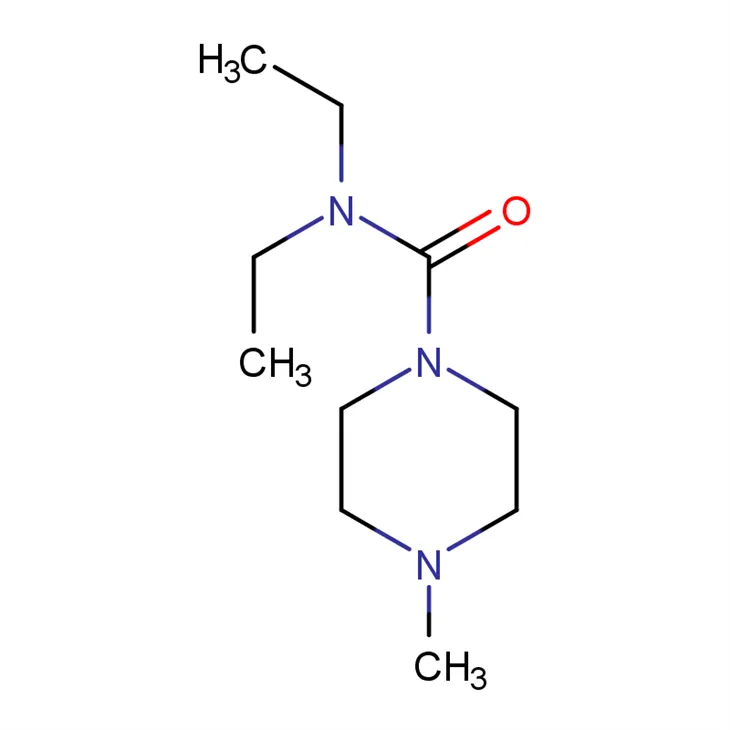
N,N-Diethylcarbamazine CAS 90-89-1
What is N,N-Diethylcarbamazine CAS 90-89-1?
N,N-Diethylcarbamazine CAS 90-89-1 is an organic compound with the following properties:Appearance: colorless to light yellow oily liquid.
Why Choose Us
Our factory
Sichuan Biosynce Pharmaceutical Technology Co.,Ltd. was founded in 2008. Biosynce specialized in developing, supplying and marketing of pharmaceutical intermediates, API and fine chemical products.
Our products
Our products are including Pyrrole Series, Piperazine Series, Pyridine Series, Quinoline Series and Piperidine Series, also we provide CDMO, CRO and customized synthesis service for domestic and foreign customers.
R&D
Our R&D team is composed of highly qualified and experienced doctors and masters, with first-class domestic and foreign pharmaceutical chemistry industry backgrounds, rich R&D and management experience. We can continuously update the product library according to customer needs, and provide more than thousands of products in stock, with packaging ranging from grams to tons, and new stock products are added every day.
Production market
Biosynce have an independent R&D and inspection center to strictly test the quality of products and provide customers with high quality products, our products are widely exported to North America, Europe, Asia and Africa. We aim to establish long-term and mutually beneficial relationships with customers and offer excellent products and services.


Tert-Butyl 3-cyano-4-oxopyrrolidine-1-carboxylate CAS 175463-32-8

(2S,4R)-4-Aminopyrrolidine-2-carboxylic Acid CAS 16257-88-8

(2S,4S)-1-((Benzyloxy)carbonyl)-4-hydroxypyrrolidine-2-carboxylic Acid CAS 13504-86-4

(2R,4S)-4-Hydroxypyrrolidine-2-carboxylic Acid Cas 3398-22-9

Pyrrolidin-2-ylmethanamine CAS 57734-57-3

2-(Aminomethyl)pyrrolidine Dihydrochloride CAS 6149-92-4

(S)-1-Boc-2-Formylpyrrolidine CAS 69610-41-9

Features of N,N-Diethylcarbamazine CAS 90-89-1
N,N-Diethylcarbamazine CAS 90-89-1 is an organic compound with the following properties:
Appearance: Colorless to light yellow oily liquid.
Density: 0.928 g/mL.
Solubility: Soluble in water and many organic solvents.
Neuroscience research: As an intermediate for opioid receptor antagonists.
Use of Dimethylcarbamoyl
Dimethylcarbamoyl chloride has been used primarily as a chemical intermediate in the production of dyes, pharmaceuticals, pesticides, and rocket fuel (IARC 1999, HSDB 2009).
Potential routes of human exposure to dimethylcarbamoyl chloride are inhalation, ingestion, and dermal contact. Dimethylcarbamoyl chloride has been released to the environment as a result of its manufacture and use as an intermediate in the manufacture of pesticides and drugs (HSDB 2009). According to EPA's Toxics Release Inventory, environmental releases of dimethylcarbamoyl chloride have remained between 98 and 366 lb since 1997, with most releases to air and the remainder to off-site non-hazardous-waste landfills. In 2007, one facility released 260 lb of dimethylcarbamoyl chloride; most (255 lb) was released to an off-site hazardous-waste landfill, and the remainder to air (TRI 2009). Dimethylcarbamoyl chloride is not expected to persist in the environment, because it hydrolyzes rapidly in water. and moist soil (HSDB 2009). Significant potential human exposure to dimethylcarbamoyl chloride is restricted to chemical workers, pesticide formulators, dye makers, and pharmaceutical workers.
Dimethylcarbamoyl chloride appears as a clear liquid at room temperature with a pungent odor and a tear-penetrating effect, which decomposes rapidly in water.
Dimethylcarbamoyl chloride is similar with an acid chloride whose chlorine atom can be exchanged for other nucleophiles. Therefore, it is capable of reacting with alcohols, phenols and oximes to the corresponding N, N-dimethylcarbamates, with thiols to thiolourethanes, with amines and hydroxylamine to substituted ureas, and with imidazoles and triazoles to carbamoylazoles.
Preparation Methods of Dimethylcarbamoyl chloride
Dimethylcarbamoyl chloride can be synthesized through several methods:
Reaction with Phosgene and Dimethylamine
This method involves reacting phosgene with gaseous dimethylamine in a flow reactor at 275°C, yielding high production rates (90%).
Laboratory Scale Synthesis
At the laboratory scale, diphosgene or triphosgene can be reacted with an aqueous dimethylamine solution in a two-phase system of benzene-xylene and water, with sodium hydroxide as an acid scavenger.
Chlorodimethylamine Method
This more recent method involves converting chlorodimethylamine to this compound on a palladium catalyst under pressure with carbon monoxide at room temperature.
Biosynce have an independent R&D and inspection center to strictly test the quality of products and provide customers with high quality products, our products are widely exported to North America, Europe, Asia and Africa. We aim to establish long-term and mutually beneficial relationships with customers and offer excellent products and services.

FAQ
Hot Tags: n,n-diethylcarbamazine cas 90-89-1, China n,n-diethylcarbamazine cas 90-89-1 manufacturers, suppliers, factory, 4 Ethylphenyl Acrylate CAS 142913 11 9, 1 Acetylpyrrolidin 2 one CAS 932 17 2, Tert Butyl 3 aminomethyl benzylcarbamate Hydrochloride CAS 914465 97 7, Tert Butyl Ethyl Oxalate CAS 50624 94 7, 5 BROMO 2 METHYLINDOLE CAS 1075 34 9, 7 Bromoquinolin 2 1H one
Previous
No InformationYou Might Also Like





Send Inquiry